
Just so you know – some links on this page are affiliate links. If you click and buy something, I may earn a small commission (think coffee money, not a luxury vacation) at no extra cost to you. I only share things I genuinely like and believe are worth it. Thanks for supporting this little corner of the internet – it really helps keep everything running.
Funny words have a way of sneaking past the serious part of the mind. Before you even stop to think about what they mean, they have already done something to your face or your mood. A strange rhythm, an odd cluster of sounds, a ridiculous bounce in the middle of a syllable – it all creates a kind of instant delight. Language can be precise and elegant, but it can also be playful in ways that feel wonderfully unnecessary.
Some words seem to carry their own personality. They do not sit still on the page the way plain, practical words do. They wobble, rattle, puff themselves up, or collapse into silliness the moment you say them out loud. That is part of what makes them memorable. Even when they describe something small or ordinary, they manage to turn it into a moment.
There is also something deeply human about the fact that language makes room for absurdity. Not everything we say needs to sound polished or important. Sometimes the best word for a feeling, a mess, or a strange little habit is the one that sounds slightly ridiculous. It reminds you that speech is not just about efficiency. It is also about texture, humor, and the pleasure of hearing something unexpected.
A lot of funny words feel as though they were invented by accident and then somehow survived. They sound too peculiar to be official, yet there they are, sitting in dictionaries with a straight face. That contrast is part of the charm. The more proper their status becomes, the funnier they often seem. A word can be completely legitimate and still sound like a joke someone made up in a sleepy conversation.
There is a certain comfort in words that do not take themselves too seriously. They lighten the atmosphere without needing to explain anything. They can turn annoyance into comedy, confusion into something softer, and daily life into something a little less rigid. Even reading them quietly can feel like being let in on a private joke that has been traveling through time.
Maybe that is why people hold onto odd words so easily. They are not always the most useful, but they make language feel alive. They show that meaning is only part of the story, and that sound has its own strange power. A funny word does not just name something. It creates a small experience all by itself.
Silly-Sounding Words
Some words are funny before they even reach the brain. Their sounds tumble around in such an awkward or cheerful way that they seem to entertain the ear first and explain themselves later. You do not need to analyze them too much to feel their effect. They arrive with a kind of built-in mischief.
That is part of the charm of language at its most unguarded. A silly-sounding word can make something minor feel theatrical and make something serious lose a bit of its stiffness. It adds movement, color, and a little comic exaggeration to ordinary speech. Even one odd word can change the whole temperature of a sentence.

Kerfuffle (ker-FUFF-ul) – A commotion or fuss; amusing because it perfectly mimics the chaos it describes.
Brouhaha (BROO-hah-hah) – A noisy situation; funny because saying it actually creates a mini commotion in your mouth.
Cattywampus (KAT-ee-WOM-pus) – Something that’s askew or positioned diagonally; humorous because it sounds as crooked as its meaning.
Lollygag (LOL-ee-gag) – To dawdle or waste time; funny because it sounds like what a lazy person would invent.
Discombobulate (dis-kum-BOB-yoo-late) – To confuse or disconcert; amusing because it physically feels discombobulating to pronounce.
Gobbledygook (GOB-ul-dee-gook) – Nonsensical language; funny because it’s an example of the very thing it describes.
Mugwump (MUG-wump) – An independent politician; humorous because it sounds like a grumpy creature from a children’s book.
Snollygoster (SNOL-ee-gos-ter) – A dishonest person, especially a politician; funny because it sounds like a mythical swamp creature.
Bumfuzzle (BUM-fuz-ul) – To confuse or fluster; amusing because it sounds exactly like how being confused feels.
Taradiddle (TARA-did-ul) – A petty lie or pretentious nonsense; funny because it sounds like something a child would make up.
Oddly Specific Words
Some words feel almost suspiciously precise. They do not describe broad emotions or common actions, but one oddly narrow experience that somehow needed its own name. There is something satisfying about that level of detail. It makes the world feel both stranger and more closely observed.
These kinds of words often sound especially funny because of the contrast they create. A grand or peculiar sound gets attached to something tiny, practical, or highly specific, and the result feels delightfully uneven. They remind you that language has room not just for what is important, but for what is oddly exact. That exactness can be ridiculous in the best possible way.
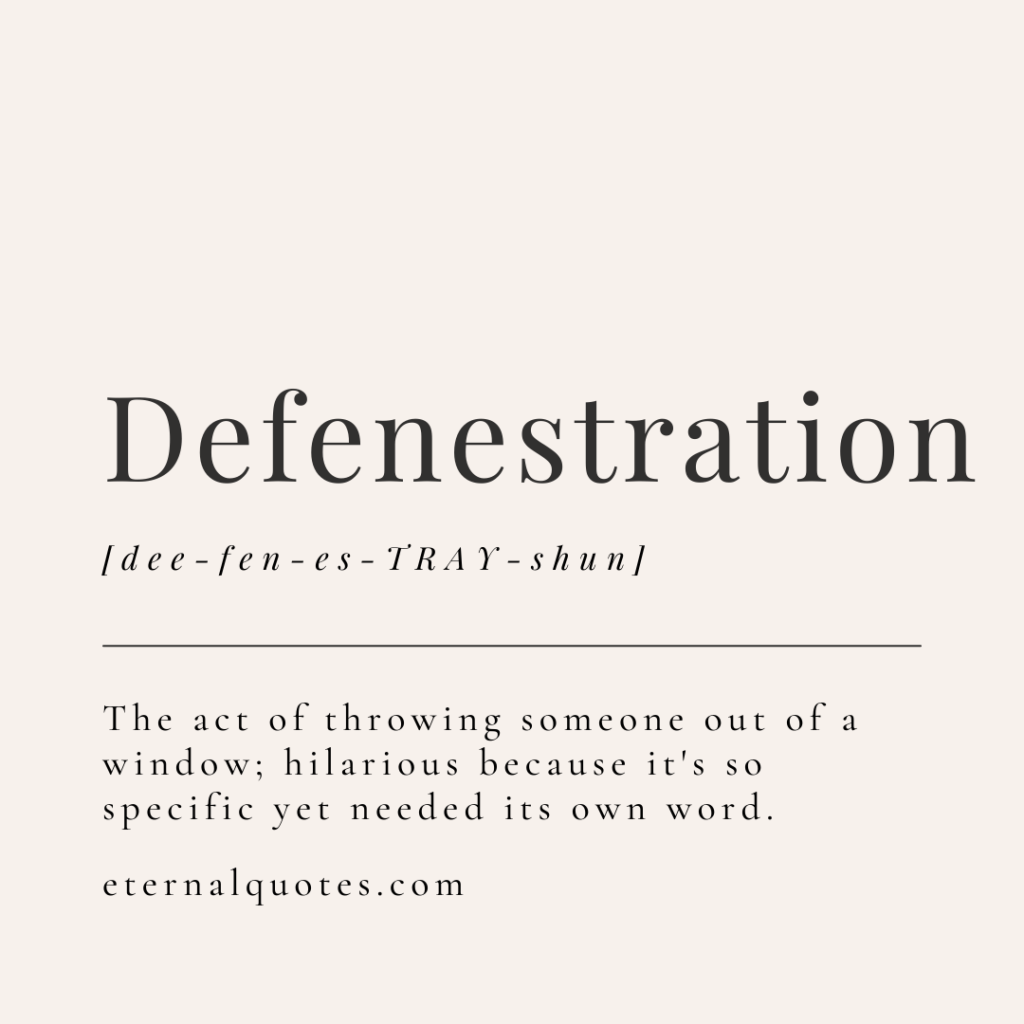
Borborygmus (bor-buh-RIG-mus) – The rumbling noise your stomach makes when hungry; funny because it sounds like what it describes.
Widdershins (WID-er-shins) – Moving counterclockwise or in the wrong direction; amusing because it sounds like a witch’s spell.
Pogonotrophy (poh-guh-NOT-ruh-fee) – The act of growing and grooming a beard; humorous because it makes beard-growing sound scientific.
Mumpsimus (MUMP-si-mus) – A person who stubbornly adheres to old customs despite evidence they’re wrong; funny because it sounds like a disease.
Apricity (ah-PRIS-i-tee) – The warmth of the sun in winter; delightful because it’s such a specific pleasant sensation.
Tittynope (TIT-ee-nope) – A small quantity of something left over; amusing because it sounds naughty but isn’t.
Gongoozler (GON-goo-zler) – A person who enjoys watching activities on canals; funny because it sounds like what someone might do after drinking too much.
Griffonage (GRIF-on-ahj) – Careless handwriting or illegible scrawl; humorous because it sounds fancy but describes something messy.
Zhuzh (ZHOOZH) – To make more exciting by adding a finishing touch; funny because it sounds exactly like the action it describes.
Bibble (BIB-ul) – To drink often or continuously; amusing because it sounds like the noise liquid makes when poured.
Animal-Related Funny Words
Words tied to animals often carry a certain looseness that makes them especially enjoyable to say. Maybe it is because animals already bring movement, sound, and personality into the imagination so quickly. The word does not arrive empty. It arrives trailing images behind it.
Even when the meaning is not directly about a creature, an animal-like sound can make a word feel more alive. It can seem skittish, awkward, energetic, or faintly absurd before you have even defined it. That liveliness gives these words a kind of comic body. They feel less like labels and more like little performances.
Kittycorner (KIT-ee-kor-ner) – Positioned diagonally; humorous because it conjures images of cats hiding in corners.
Jentacular (jen-TAK-yoo-lar) – Relating to breakfast; funny because it sounds like a tentacled sea creature’s morning routine.
Fartlek (FART-lek) – A training method alternating fast and slow running; funny because, well, it has “fart” in it.
Quokka (KWOK-uh) – A small wallaby known for appearing to smile; humorous because the name sounds as cute as the animal looks.
Dik-dik (DIK-dik) – A small African antelope; amusing because of the childish-sounding repetition.
Skedaddle (skuh-DAD-ul) – To depart quickly; funny because it sounds like how a cartoon character might run away.
Screech (SKREECH) – A harsh, high-pitched sound; amusing because it mimics the very sound it describes.
Flummox (FLUM-oks) – To perplex or confuse; funny because it sounds like a confused animal stumbling around.
Crepuscular (kruh-PUS-kyuh-lar) – Active at twilight; humorous because it sounds sophisticated for describing when animals are awake.
Pootling (POOT-ling) – Moving in a leisurely manner; amusing because it sounds like an animal moving slowly with gas issues.
Outdated Slang That Sounds Funny Now
Old slang has a special kind of humor because it carries the confidence of another era. People once said these words naturally, without any sense that they might sound theatrical or odd decades later. Time changes the atmosphere around language. What was once casual can start to feel almost costume-like.
That distance is part of the pleasure. An outdated word often sounds as if it belongs to a different social rhythm, one with its own gestures and exaggerations. You can hear a whole mood inside it – a bit of drama, a bit of swagger, maybe a little nonsense too. Even when the meaning stays clear, the tone has become charmingly unfamiliar.
Sockdolager (sok-DOL-uh-jer) – An exceptional person or thing; amusing because it sounds like someone who really hates socks.
Rapscallion (rap-SKAL-yun) – A mischievous person; funny because it sounds like a fancy onion.
Hornswoggle (HORN-swog-ul) – To deceive or trick someone; humorous because it sounds like something cowboys would say.
Fuddy-duddy (FUD-ee-dud-ee) – An old-fashioned, fussy person; funny because repeating the sounds mimics a complaining elder.
Rannygazoo (RAN-ee-guh-zoo) – Nonsensical behavior or a deceptive story; humorous because it sounds like a chaotic zoo.
Whippersnapper (WIP-er-snap-er) – A young, presumptuous person; amusing because it sounds like someone who snaps whips for fun.
Bumbershoot (BUM-ber-shoot) – An umbrella; funny because it’s an overly complex way to say something simple.
Shenanigans (shuh-NAN-i-ganz) – Mischievous behavior; humorous because saying it feels like participating in mischief.
Malarkey (muh-LAR-kee) – Nonsense or rubbish; amusing because it sounds like something a cartoon character would yell.
Hunky-dory (HUN-kee-DOR-ee) – Fine or satisfactory; funny because it sounds like a description of an attractive door.
Funny-Sounding Scientific Terms
Scientific language often aims for clarity, but that does not stop it from sounding bizarre to everyone outside the field. In fact, the more technical a term becomes, the more likely it is to seem oddly theatrical in ordinary conversation. A plain bodily process or familiar object suddenly gets dressed in elaborate syllables. That seriousness can become funny all by itself.
There is something enjoyable about that collision between precision and absurd sound. A highly formal word can make a very ordinary thing feel almost alien for a moment. It reminds you that language shifts depending on context, and that expertise has its own music. Sometimes that music is dignified, and sometimes it sounds like someone made it up five seconds ago.

Titillate (TIT-ill-ate) – To excite pleasurably; amusing because it sounds mildly inappropriate despite being perfectly scientific.
Uvula (YOO-vyoo-luh) – The hanging fleshy extension at the back of your throat; funny because it sounds like an alien body part.
Flagellum (fluh-JEL-um) – A whip-like appendage on certain cells; humorous because it sounds like a Harry Potter spell.
Mastication (mas-ti-KAY-shun) – The process of chewing; funny because it sounds far more elaborate than simply “chewing.”
Weevil (WEE-vul) – A type of beetle; amusing because it sounds like a sad villain from a children’s book.
Glabella (gluh-BEL-uh) – The space between your eyebrows; funny because it sounds like a made-up princess name.
Fecund (FEE-kund) – Fertile or productive; humorous because it sounds like an impolite biological term.
Flocculation (flok-yoo-LAY-shun) – The process of forming wool-like clumps; amusing because it sounds like a fancy hairdo.
Philtrum (FIL-trum) – The groove between your nose and upper lip; humorous because it sounds like a magical potion ingredient.
Coccyx (KOK-siks) – Tailbone; funny because it sounds inappropriate but is actually a clinical term.
Words That Sound Like What They Mean
Some words feel unusually satisfying because they seem to carry their meaning in their sound. You hear them and already have a rough sense of their shape, force, or movement before anyone defines them. That creates a small moment of alignment between sound and experience. It is one of the simplest pleasures language can offer.
These words often feel vivid because they are not just telling you something. They are doing something while they speak. A splash, a wobble, a sharp stop, a soft collapse – all of that can live inside a single sound. When language works like that, it feels less abstract and much more physical.

Bobble (BOB-ul) – To move up and down in a jerky way; amusing because saying it makes your mouth bobble.
Titter (TIT-er) – A nervous laugh; humorous because it sounds exactly like a suppressed laugh.
Zigzag (ZIG-zag) – A line with sharp turns; funny because saying it makes your voice zigzag.
Hiccup (HIK-up) – An involuntary spasm of the diaphragm; amusing because it sounds like the noise it produces.
Plop (PLOP) – To drop or fall heavily; funny because it perfectly mimics the sound of something falling into liquid.
Waddle (WOD-ul) – To walk with short steps, swaying from side to side; humorous because saying it makes you feel like you’re waddling.
Splat (SPLAT) – The sound of something soft hitting a surface; amusing because it’s impossible to say without imagining the impact.
Fizz (FIZZ) – To make a hissing or bubbling sound; funny because it sounds effervescent when spoken.
Gargle (GAR-gul) – To rinse one’s mouth with liquid; humorous because it sounds like what you’re doing when gargling.
Squelch (SKWELCH) – A sucking sound made by walking through mud; amusing because saying it feels like stepping in something wet.
Funny Foreign Words Adopted in English
Borrowed words often keep a trace of the place they came from, and that trace can make them feel extra vivid. They arrive carrying a slightly different rhythm, a different texture in the mouth, sometimes even a different attitude. Once they settle into English, they still keep that sense of having traveled. That unfamiliarity is part of what makes them stand out.
Sometimes a borrowed word becomes so natural that people forget it was ever foreign at all. Yet it still sounds a little brighter or stranger than the words around it. That difference gives it energy. It reminds you that language is never fully closed and that humor often slips in through the edges where worlds meet.

Flapdoodle (FLAP-doo-dul) – Nonsense (British); humorous because it sounds like something a cartoon bird would say.
Schlep (SHLEP) – To drag or haul (Yiddish); funny because it sounds as tiresome as the action it describes.
Klutz (KLUTZ) – A clumsy person (Yiddish); amusing because it sounds like someone tripping over their own feet.
Gesundheit (guh-ZUNT-hite) – Said after someone sneezes (German); humorous because English speakers adopted a foreign word that sounds like a blessing.
Kaput (kuh-PUT) – Broken or useless (German); funny because it sounds like the noise something might make when breaking.
Verklempt (fer-KLEMT) – Overcome with emotion (Yiddish); amusing because it sounds like someone choking up.
Canoodle (kuh-NOO-dul) – To kiss and cuddle (possibly British dialect); humorous because it sounds like a hybrid pasta dish.
Schmooze (SHMOOZ) – To chat in a friendly way, often to gain favor (Yiddish); amusing because it sounds like what your mouth does while talking.
Oomph (OOMF) – Energy or sex appeal (Germanic); funny because it sounds like the noise you make when exerting energy.
Doppelgänger (DOP-pel-gang-er) – A look-alike of a person (German); amusing because it sounds spooky and mysterious.
Food and Drink Related Funny Words
Food words are often close to the body, the mouth, and the small habits of appetite, which is probably why they can sound so comical. They tend to be blunt, rounded, chewy, or exaggerated in a way that feels immediate. You can almost hear the act of eating or drinking inside them. That closeness makes them easy to enjoy.
There is also something disarming about culinary language when it becomes playful. It takes ordinary hunger, taste, or excess and gives it a bit of theatrical flair. A snack can sound mischievous, a sip can sound dramatic, and a simple chew can become oddly expressive. Everyday bodily life becomes a little more entertaining through the words attached to it.

Spifflicate (SPIF-li-kate) – To confound or beat up; humorous because it sounds like a fancy coffee preparation.
Wamble (WOM-bul) – Stomach rumbling; funny because it sounds like a breakfast cereal for seniors.
Namby-pamby (NAM-bee-PAM-bee) – Lacking energy or courage; humorous because it sounds like a fancy sandwich.
Munch (MUNCH) – To chew with a strong action; amusing because saying it makes your mouth do the action.
Nosh (NOSH) – A light meal or snack; humorous because it’s short, direct, and sounds like what it describes.
Slurp (SLURP) – To eat or drink noisily; funny because it’s onomatopoeic and slightly impolite.
Scrumptious (SKRUMP-shuss) – Delicious; amusing because it sounds over-the-top and enthusiastic.
Guzzle (GUZ-ul) – To drink greedily; humorous because it sounds like the noise made when drinking quickly.
Nibble (NIB-ul) – To take small bites; funny because it sounds tiny and cute, just like the action.
Snack (SNAK) – A small amount of food eaten between meals; amusing because it sounds like the action of eating something quickly.
Body Part Words That Sound Funny
The body is full of names people rarely say out loud unless they have to. When those names finally do appear, they can sound unexpectedly dramatic, delicate, or absurd. It is strange how often the language of anatomy feels more theatrical than the body itself. A simple part suddenly seems much more mysterious once it has a formal name.
That gap between the familiar body and the unfamiliar word creates a quiet kind of comedy. You know exactly what is being described, yet the term makes it sound like something from a laboratory, a Latin chant, or an old medical handbook. It adds distance to something deeply ordinary. That distance is what makes these words so oddly entertaining.

Axilla (ak-SIL-uh) – The armpit; funny because it sounds like a fancy vacation destination.
Phalanges (fuh-LAN-jeez) – Bones of the fingers and toes; amusing because it sounds like a disease.
Sternum (STUR-num) – Breastbone; humorous because it sounds like a spell from Harry Potter.
Patella (puh-TEL-uh) – Kneecap; funny because it sounds like a fancy Italian dish.
Integument (in-TEG-yoo-ment) – Skin or other natural covering; amusing because it sounds like a fancy word for a blanket.
Medulla (meh-DUL-uh) – The inner region of an organ; humorous because it sounds like a magic spell.
Mandible (MAN-di-bul) – Lower jawbone; funny because it sounds like something you’d use to slice vegetables.
Pancreas (PAN-kree-us) – Digestive gland; amusing because it sounds like a Greek philosopher.
Duodenum (doo-oh-DEE-num) – First part of the small intestine; humorous because it sounds like a magical incantation.
Tragus (TRAY-gus) – The small pointed part of your ear; funny because it sounds like a mythical creature.
The Pleasure of the Ridiculous
Funny words stay with people for reasons that go beyond humor alone. They break the rhythm of ordinary speech and make room for surprise. In a language full of routine, they feel like little interruptions of character. They remind you that communication is not only about getting through the day efficiently.
There is something oddly comforting about words that are a bit unruly. They make room for play without asking permission, and they soften the edges of seriousness in a way that feels natural rather than forced. Even when they describe confusion, noise, hunger, or awkwardness, they make those things feel easier to carry. A ridiculous sound can make the world seem less stiff.
Part of their appeal is that they resist flattening. Plain words often do their job and disappear, but strange words linger. They echo in the mind, not because they are more important, but because they are more alive. They have shape, bounce, attitude, and sometimes a little absurd dignity. That makes them harder to forget.
They also reveal something honest about language itself. Speech is not a perfectly polished system built only for order. It is full of accidents, inheritances, experiments, and sounds that somehow survived because people liked them. A funny word is often a small record of that messiness. It shows that usefulness and delight have always lived side by side.
Maybe that is why odd words can feel strangely generous. They offer a brief pause from the flatness of practical talk and make even an ordinary moment feel a little more textured. You say one aloud and the sentence opens up. There is more room in it now – more mood, more image, more personality. Something small becomes memorable for no serious reason at all.
In the end, that may be enough. Not every word needs to be graceful, and not every beautiful thing has to be elegant. Some of the most enjoyable parts of language are the ones that wobble, clatter, and grin on the way out of the mouth. They leave behind a slight sense of delight, which is sometimes more valuable than precision alone.